
What Is Your Growth Geometry? (Part 2)
Learning/Knowing and doing
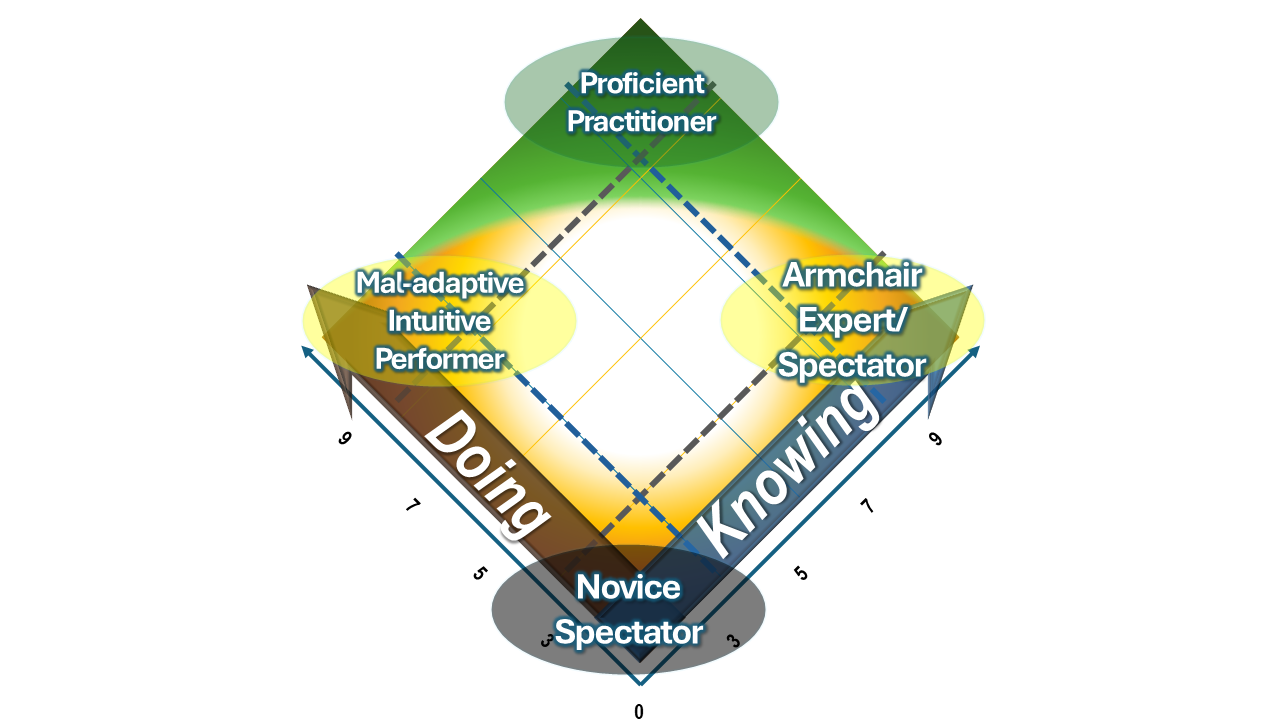
The second tension governs how fast the curve can rise at all.
Learning and knowing expands understanding — new ideas, frameworks, skills, perspectives. Doing converts understanding into experience, testing assumptions and generating the feedback that makes further learning possible.
Learning without doing becomes intellectual avoidance: another book, another program, another credential, one more revision of the plan, and never the situation where the new understanding has to perform. Doing without learning produces a different failure: constant activity that repeats familiar patterns, where experience accumulates but capability does not.
The productive pattern is a cycle — learn,know, apply, observe, reflect, adjust, apply again — in which action is not the end of learning but part of it. Leadership, communication, and judgment cannot be acquired through information alone. They develop through repeated contact with real people, competing priorities, incomplete information, and uncomfortable consequences.
The goal is not to be fully prepared before acting. That moment rarely arrives. The goal is to learn enough to take the next thoughtful step and let experience teach the rest.
Why these tensions keep coming back
Here is what most treatments of these tensions leave out: not what they are, but why they recur.
The reason is structural, and it has a geometry. When you lean hard into one pole, the benefits often arrive quickly and the costs arrive slowly. Push self-improvement and the capability gains show up in weeks; the erosion of confidence shows up in months. By the time the cost becomes visible, you have been over-rotated for a long stretch — so the correction, when it finally comes, is large. Then you over-rotate the other way.
That delay is the entire mechanism. It is why these tensions oscillate instead of settling, and why a tension you thought you had resolved two years ago is back. You did not fail to resolve it. It is not the kind of thing that resolves.
This is what we mean by a PICT — a Persistent Interdependent Contradictory Tension. Persistent, because the structure regenerates it. Interdependent, because each pole’s downside is the other pole’s best argument. Contradictory, because both are right.
The practical consequence changes what you work on. Stop hunting for the balance point. Start shortening the delay. If you can see the cost of over-rotation in weeks instead of months, your corrections get smaller and your curve gets smoother — without ever resolving the tension at all.
Shortening the delay is not a Human Plane move. It is an Information Plane move.
The Information Plane: What Reaches You, and When
Self-awareness is usually discussed as a personal quality. It is more usefully treated as an information system with three properties.
(Stay tuned for third installment)