What is your Growth Geometry?
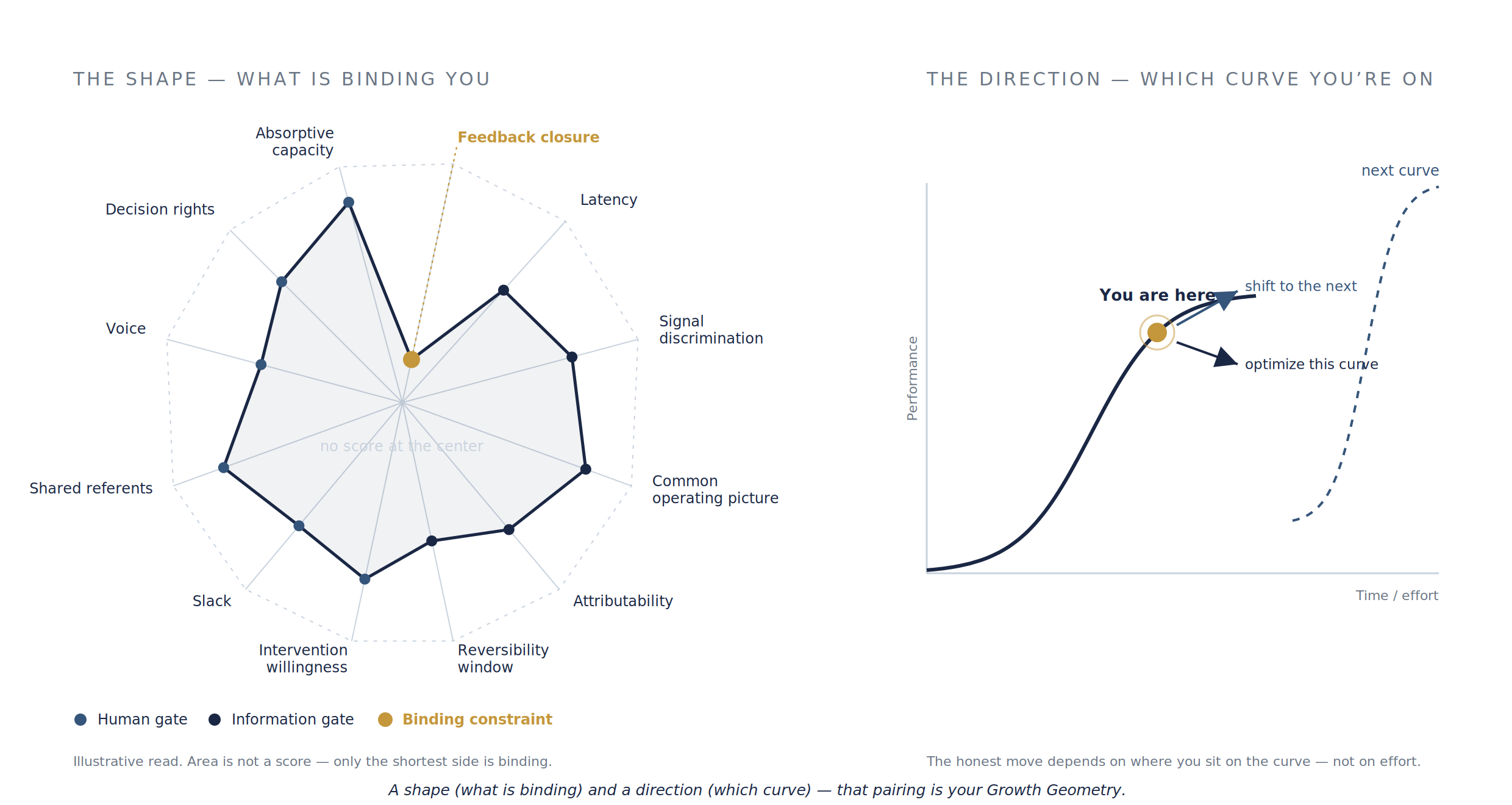
Every organization has a shape and a direction. The shape is set by the constraints that are actually binding you. The direction is set by which curve you’re on. Most improvement programs fail because they add effort to a shape that can’t absorb it.
You’ve already tried the obvious things.
You hired better people. You bought the platform. You ran the training. You rewrote the process. Some of it worked for a quarter.
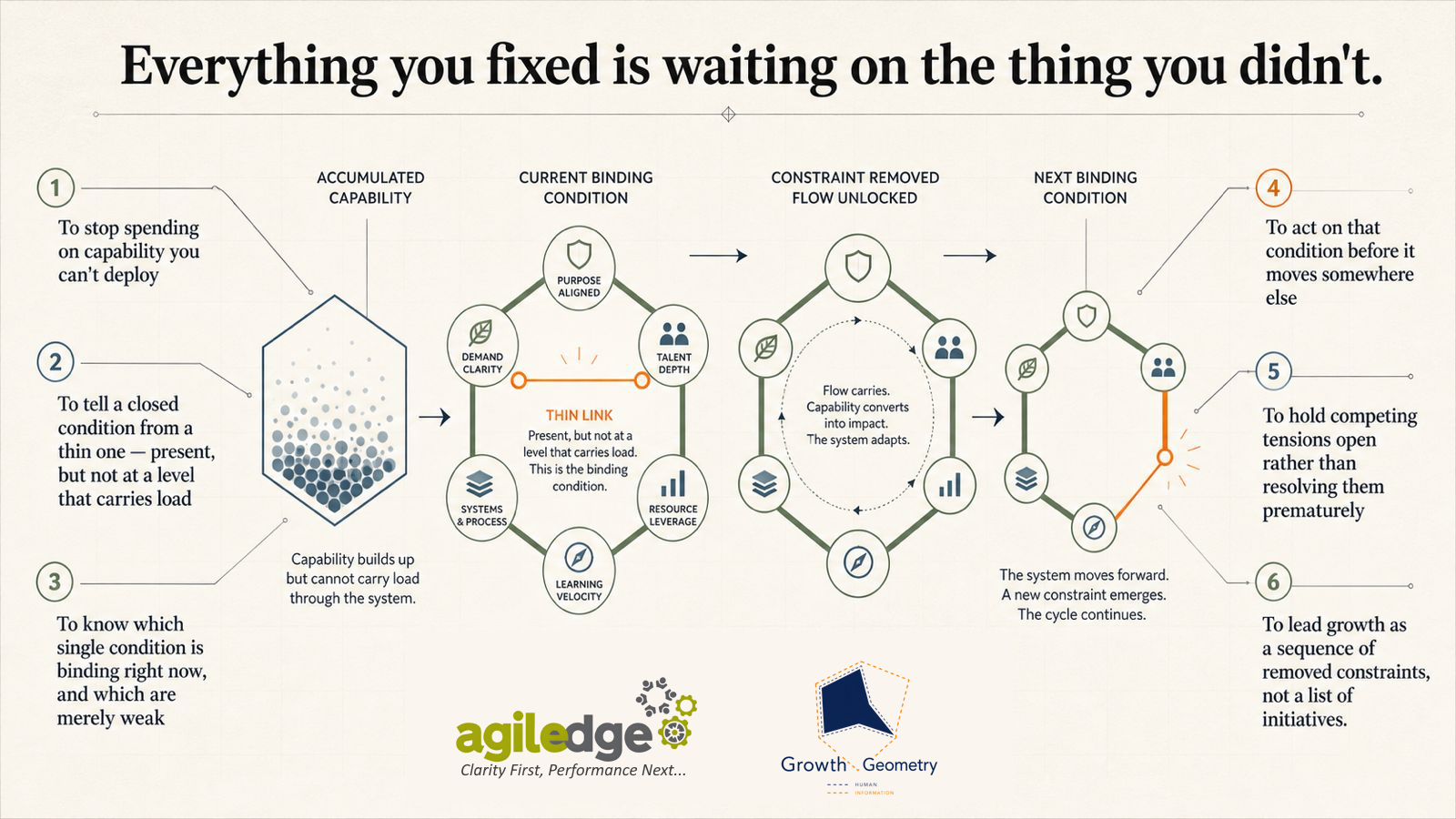
Here’s why the rest didn’t: improvement is additive, but constraints are not. You can pour capability into an organization all day, and if one condition is missing, nothing moves. The training doesn’t fail because it was bad training. It fails because the people you trained don’t have the decision rights to use what they learned — or because the information they’d need to act on arrives three weeks late, or not at all.
Most consulting models are compensatory: they score you across a dozen dimensions and tell you that strength here offsets weakness there. In the real world it doesn’t offset. A constraint is a constraint.
“The distinction that runs through everything we do: Constraints explain why improvement fails. Capabilities explain where growth comes from. You have to know which one you’re dealing with before you spend a dollar.”
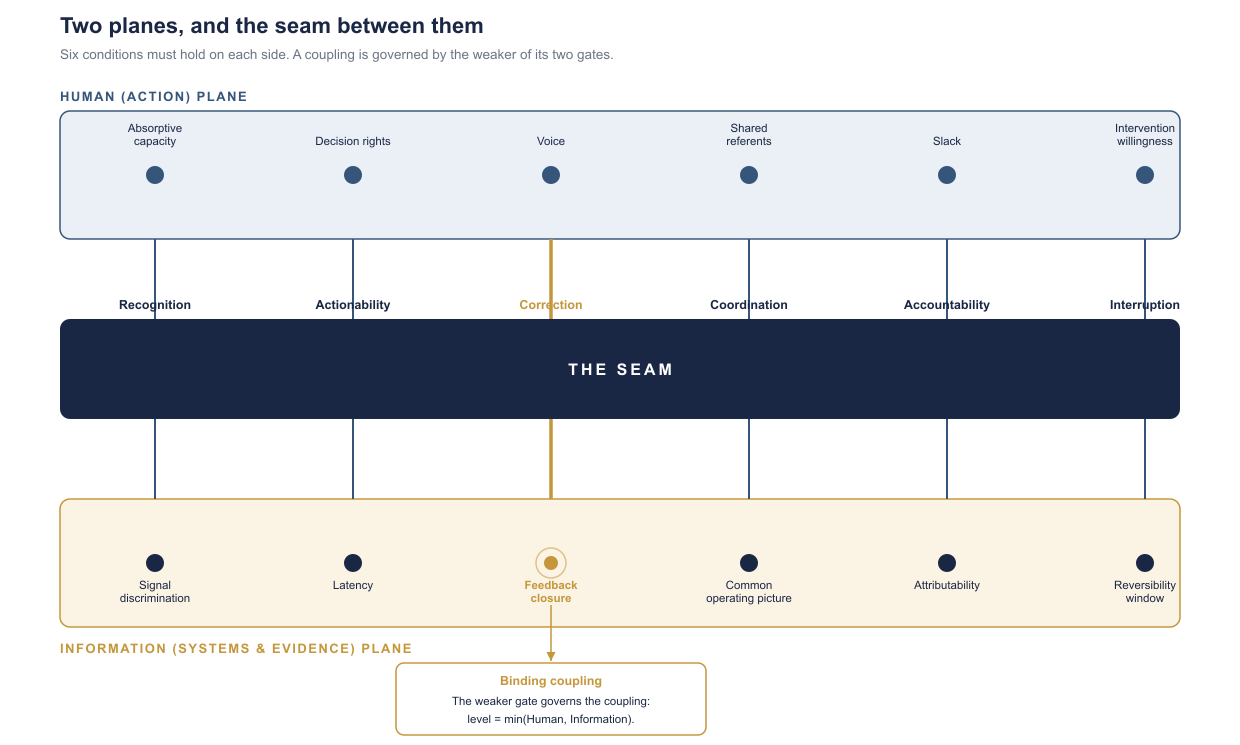
Two planes, and the seam between them.
Work gets done in two places at once.
The Human (action) Plane — the conditions under which people, teams, and now agents can actually act. Whether someone can absorb new information. Whether they hold the decision rights. Whether they’ll speak up. Whether there’s any slack to act with. Whether anyone is willing to stop the line.
The Information (systems and evidence) Plane — the signal, the record, the representation. Whether the signal is distinguishable from noise. Whether the answer arrives in time to matter. Whether feedback ever closes. Whether everyone is working from the same picture. Whether anything is attributable. Whether a decision can be reversed once it’s made.
The Seam is where the two meet. It’s where almost every expensive organizational failure actually lives — not inside the people, not inside the systems, but in the crossing between them.
Six conditions have to hold on each side. We read all twelve, find which ones are binding, and show you the shape that results.
What makes this different
Four things, stated plainly:
We never give you a single score.
No maturity level. No composite index. No “you’re a 3.4 out of 5.” A composite number averages away the exact thing you hired us to find — the one condition that’s blocking everything else. We will tell you which constraint is binding and what it’s costing you. That is a harder answer to produce and a more useful one to own.
We read both planes, and we say out loud what our instruments can’t see.
Behavioral assessment is powerful on the human side and structurally silent on the information side. Anyone selling you a personality instrument as an organizational diagnosis is selling you half a picture. We tell you where each method reaches its limit.
We measure the unit where work actually happens.
A clinic. A depot. A branch. A crew. Firm-level diagnostics tell you what executives already believe. Unit-level diagnostics tell you what’s true.
Thirty years of doing the work, not just modeling it.
AgilEdge has advised 300+ organizations since 1996 — from owner-operated businesses to Hitachi, L3Harris, and Lockheed Martin.
What you actually get
Start with the Information Plane read: Time-to-Answer
The fastest, least invasive way in. We take a real question your organization needs answered — the kind a manager asks on a Tuesday — and we trace it. How long until an answer exists. How long until the right person has it. Whether it’s trustworthy when it lands. Whether anyone acted on it.
You receive:
A traced map of how information actually moves, against how you believe it moves
Which of the six information conditions are binding, with the evidence
What the delay is costing in decisions deferred, rework, and missed windows
A candid closing section: what we could not resolve without reading the Human Plane, and why
That last clause does real work. It converts a diagnostic purchase into a first installment and removes the “will this go anywhere” objection.
The complete read: Your Growth Geometry
Both planes. All twelve conditions. Scored at the unit level, plus the outward read at your customer and stakeholder boundary.
You receive:
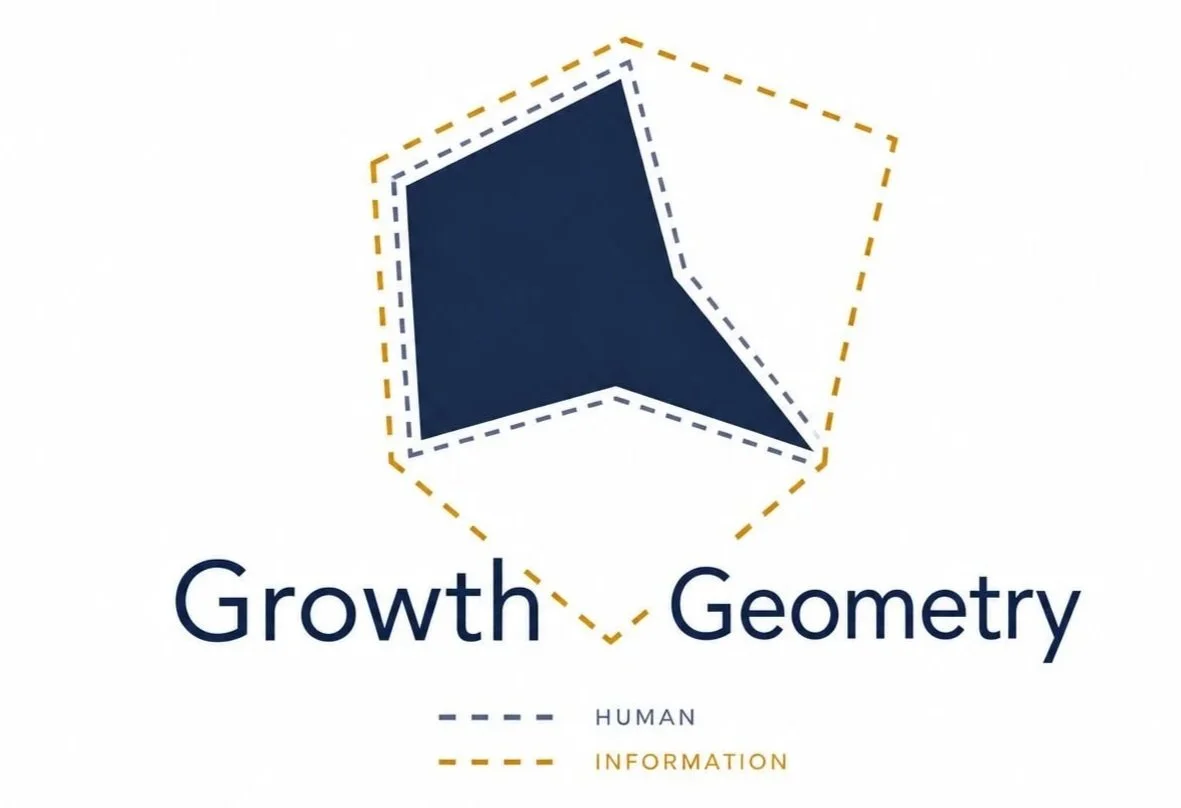
Your constraint polygon — the shape, with the binding constraints named
Your position on the current S-curve, and whether the honest move is to optimize this curve or shift to the next one
A sequenced plan: what to fix first, what not to bother with yet, and what stops mattering once the binding constraint clears
The evidence behind every call, in a form you can hand to a skeptic
Who this is for
Growth Geometry fits organizations where:
You’ve spent real money on improvement and can’t point to what changed
Two functions each believe the other is the problem, and both are partly right
You’re deploying AI or automation into a process nobody has honestly mapped
Growth stalled and the usual explanations — market, people, effort — don’t hold up
You’re the leader everyone brings problems to, and you’ve stopped being sure which ones are actually yours

Questions people ask
Is this an assessment?
Partly. Assessment is one input. The read also includes structured interviews, an artifact review, and a trace of how information actually moves. We don’t diagnose an organization from a questionnaire.
How is this different from a maturity model?
A maturity model tells you where you sit relative to a benchmark. It assumes weaknesses can be compensated by strengths and that everyone should progress along the same path. Growth Geometry finds what is binding you, in your configuration, and tells you which single thing to move first. Benchmarks describe a population. Constraints describe you.
Do you need everyone to take a test?
No. We scale to what you’ll allow. We’ve run useful reads with a single day of interviews and no assessments at all. More access buys more precision, and we’ll tell you exactly what precision you’re giving up.
What about AI and agents?
Agents act, and they’re also part of the information layer — which means they sit in both planes at once. Every condition we read applies to them: what they’re authorized to do, whether anyone can interrupt them, whether their work is attributable, whether their decisions are reversible. Most failed AI deployments are constraint failures wearing a technology costume.

You Can't Redesign What You Haven't Understood
Right now, in many organizations I talk to, someone is arguing that the work should be rethought from zero. AI changes everything, so why document a process you're about to delete?
I've heard this argument before. It was called reengineering the first time and ERP the second, and it failed the same way both times — not because rethinking was wrong, but because the people doing the rethinking did not know what the current work was really accomplishing. You will not learn what really must get done, and why, until you understand what has been going on. Half of what looks like waste is a workaround holding up something no one has looked at in years. Delete it from a clean sheet and you find out what it was for, very expensively.
That's the piece of Deming that survived everything for me: see the work as it actually occurs, not as the diagram claims. I spent my early career doing exactly that — mapping and transforming processes, driving out variation. And I watched those efforts stall, repeatedly, at implementation. Not because the ideas or the map was wrong. Because we had been rigorous about the what and the how and nearly silent on the who (and the “why” on the who)
So I spent the many years on the other half. Two hundred–plus companies, building self-awareness, role fit, and leadership capability. Better work, and it held better — until it ran into the mirror image of the first problem. Capable, well-matched people whose capability sat unused, because information didn't reach them in time, or the record was wrong, or nobody could say who had decided what.
Both halves taught the same lesson, which is why the order of the questions is wrong nearly everywhere. Companies jump to what should we improve? The initial focus should always be: what is currently blocking us? Then it is helpful to understand if it is on the human side of the house or the information (systems and evidence) side?
That question has an answer, and the answer has a shape. Some conditions in an organization are necessary: if one is missing, nothing you add on top of it compensates. Others are contributory — more helps, in proportion. Improvement budgets go almost entirely to the contributory kind, because those are the ones with vendors and case studies attached, while one necessary condition stays closed and holds the ceiling down on everything else. It's like the vacation where you've bought the flights, booked the hotel, arranged the rental car, and forgot you let the passport expire. You got great deals and created a lot of excitement. All of it is worth nothing on the departure day.
In Growth Geometry, those necessary conditions are called gates. A gate is an operating or flow condition — the circumstance required for work to move from one part of the system to the next. Some are human: who can decide, who will say the new way isn't working, who is willing to stop the line. Some are informational: what gets recorded, what can be traced, what arrives in time to matter. Most organizations are stuck at a crossing between the two, and they're stuck at the unit level — this depot, this clinic, this branch — not as a company-wide grade.
Before you improve the work, find out what shape it's in.
What is your Growth Geometry?
An Example of a Growth Geometry:
What’s holding you back?