
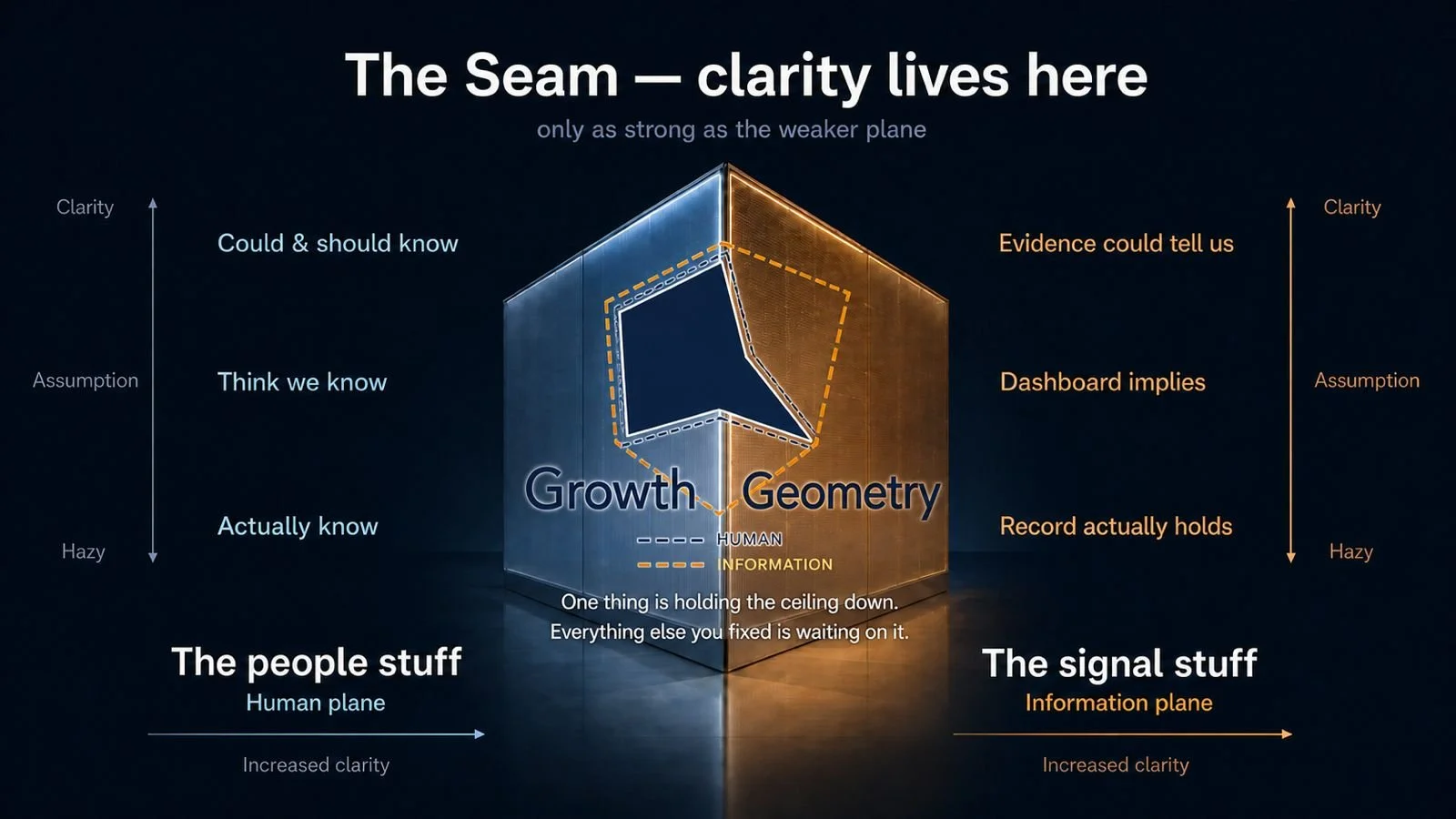

Most improvement work begins in the middle — deciding what to build before anyone has read the structure it is being built on. What a structural read almost always finds is that the organization already holds more capability than it can use: talent that cannot act, data that arrives too late, authority pointed at the wrong information.
Growth Geometry reads the structure first, names what is binding, and only then asks what to build. The payoff is usually not new capability but the release of capability the organization already has and cannot deploy. Removing what binds turns existing talent, data, and authority into work that actually moves, without a new budget line. It all flows to the top line.


Right Data: People Decisions with Clarity
Improve People Decisions
With People Clarity (Actionable Understanding),
A Focus on the 4 Key Catalytic Roles of Managers Produces Tremendous Results:


The Manager Who Will Stop the Line (Self-Manager)
Failure Mode: Sees the problem, doesn't call it. Escalation happens one level too late, every time.
Cultivates self-awareness and emotional intelligence with self-management to model personal effectiveness and ensure optimal alignment between capabilities and role demands.
The Manager Who Owns the Crossing (Process Manager)
Failure Mode: Leading indicators exist. The person who can act on them needs three approvals.
Orchestrates workflow excellence by integrating AI and other technology. Balancing standardization with innovation, designing efficient systems, tracking performance metrics (especially leading indicators - KPI’s), and embedding continuous improvement.


The Manager Who Makes the Picture Mean Something (Meaning-Maker)
Failure Mode: Sees the problem, doesn't call it. Escalation happens one level too late, every time.
Creates community while clarifying direction - balancing supportive relationships with performance expectations inspiring collective commitment and individual accountability. Translates vision into meaningful daily actions nurturing relationships to sustain engagement/ fulfillment.
The Manager Who Builds the Capacity to Absorb (Coach/Mentor)
Failure Mode: New method arrives. Team has no slack to learn it, so it's adopted in name only.
Invests in capability building through feedback, stretch assignments, and career conversations that develop both current competencies and future potential. Provides support at the edge of comfort zones where challenge meets achievability for maximum skill development.
Core Capabilities and Focus Domains

Shape and Direction: Where You Are on the Curve

Why Capable People Don't Act

Navigating PICTs

Shared Referents: When the Team Isn't Looking at the Same Picture

Who Actually Hears It: Networks, Voice, and Feedback Closure

The Seam: Where Knowing Fails to Become Doing
