What Is Your Growth Geometry?
Growth is rarely a smooth, continuously rising line. It is uneven — periods of rapid improvement, long plateaus, occasional setbacks, and stretches where progress becomes visible only in retrospect. Most development conversations treat that unevenness as noise to be apologized for. It isn’t noise. It’s a shape, and shapes can be read.
Over the last 20 years, we’ve worked with thousands of people in a few hundred organizations focused on improvement, but one thing, it took us many of those years to realize, is that it’s often a mistake to talk about where you are at as a fixed point- it’s far better to talk about trajectory, vectors and S curves.
Start with a question that sounds like a small change and isn’t. Nearly every assessment you have ever taken told you where you are. A score, a percentile, a position on a scale. Far more useful is knowing which way you are moving, and how fast. A position is a stationary point. A trajectory is a vector — and a vector is diagnostic in a way a dot can never be. Two leaders can sit at the identical point on the identical scale, one accelerating toward it and one drifting away from it, and they do not have the same problem or need the same conversation.
The shape of your curve is determined less by intelligence, ambition, or experience than by two things: how you handle a small number of persistent tensions, and the quality and timing of the information that reaches you about yourself. Those are two different planes, and separating them is where the diagnosis begins.
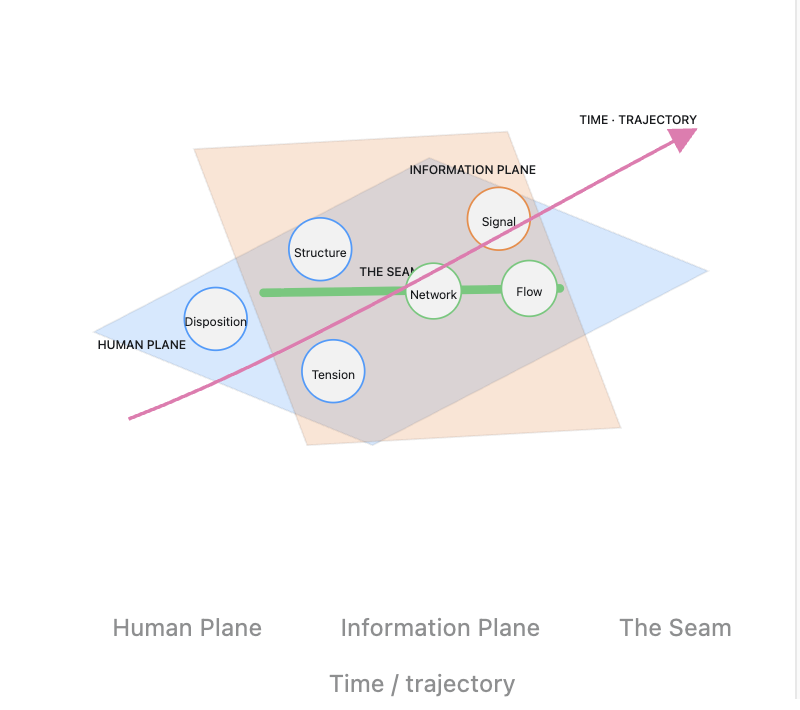
Two Planes and a Seam
The Human Plane holds your tendencies, your tensions, your relationships, your defaults under pressure. It is what almost all development work addresses.
The Information Plane holds something else entirely: what you actually know about yourself, how you came to know it, and how long it took to arrive. Which feedback reaches you. Which never does. How stale it is by the time it lands.
These get confused constantly, and the confusion is costly. A leader who keeps repeating the same mistake may have a Human Plane problem — a tendency they over-rotate on when stressed. Or they may have an Information Plane problem — nobody has told them, or told them so long after the fact that the link to cause was already lost. Those look identical from the outside and require completely different interventions.
The Seam is where the two planes meet: the point at which information becomes behavior. Most development stalls at the Seam. People know and do not change. That is typicaly not a knowledge failure and it is not a character failure. It is a Seam failure, and it has its own remedies.
The Human Plane: The Tensions That Bend the Curve
Two tensions do most of the bending.
Self-improvement and self-acceptance.
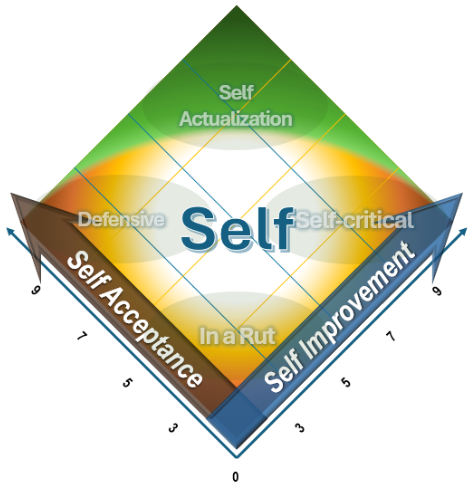
Self-improvement is the desire to become more capable, effective, and mature. It drives us to seek feedback, correct mistakes, and move toward our potential.
Self-acceptance is the ability to recognize our worth while honestly acknowledging who we are today — strengths, limitations, preferences, and imperfections — without defensiveness or shame.
At first they look contradictory. If I accept myself, will I lose the motivation to improve? If I keep focusing on improvement, am I conceding that I am not good enough? Neither, provided both stay live. Self-acceptance without self-improvement drifts toward complacency: we excuse counterproductive behavior and conclude that this is simply how we are. Self-improvement without self-acceptance curdles into relentless self-criticism: every mistake becomes evidence of inadequacy, achievement rises while confidence and resilience fall.
I am worthy and capable as I am — and I am responsible for who I am becoming.
That posture lets us examine ourselves without attacking ourselves. It replaces judgment with curiosity: not what is wrong with me, but what is this showing me, and how do I want to respond?
Self-criticism often impersonates accountability. They are not the same. Accountability identifies a gap and takes responsibility for closing it. Self-criticism converts the gap into a verdict about personal worth. Accountability says: I did not handle that conversation effectively. What can I learn and change? Self-criticism says: I am terrible at difficult conversations.
One creates movement. The other installs a limiting identity and tends to block movement in the right direction.
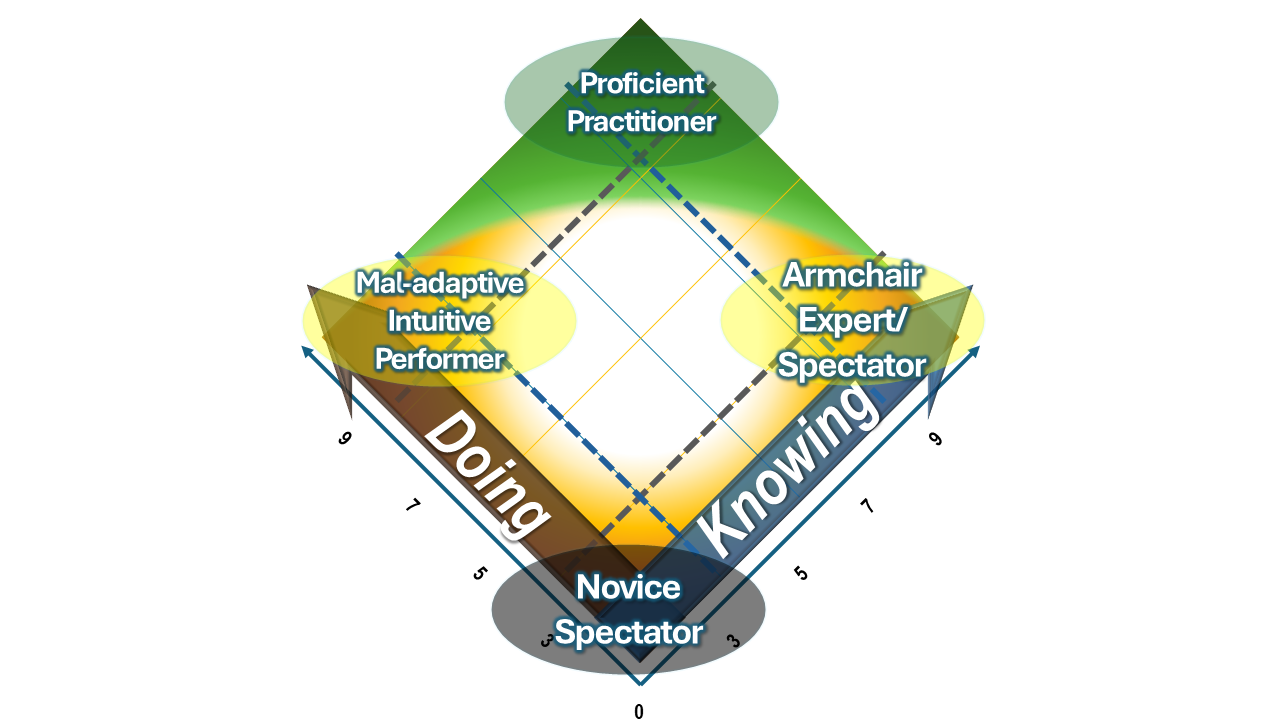
Learning/knowing and doing
The second tension governs how fast the curve can rise at all.