
Lessons in Applying Self-Awareness from Jalen and the Knicks
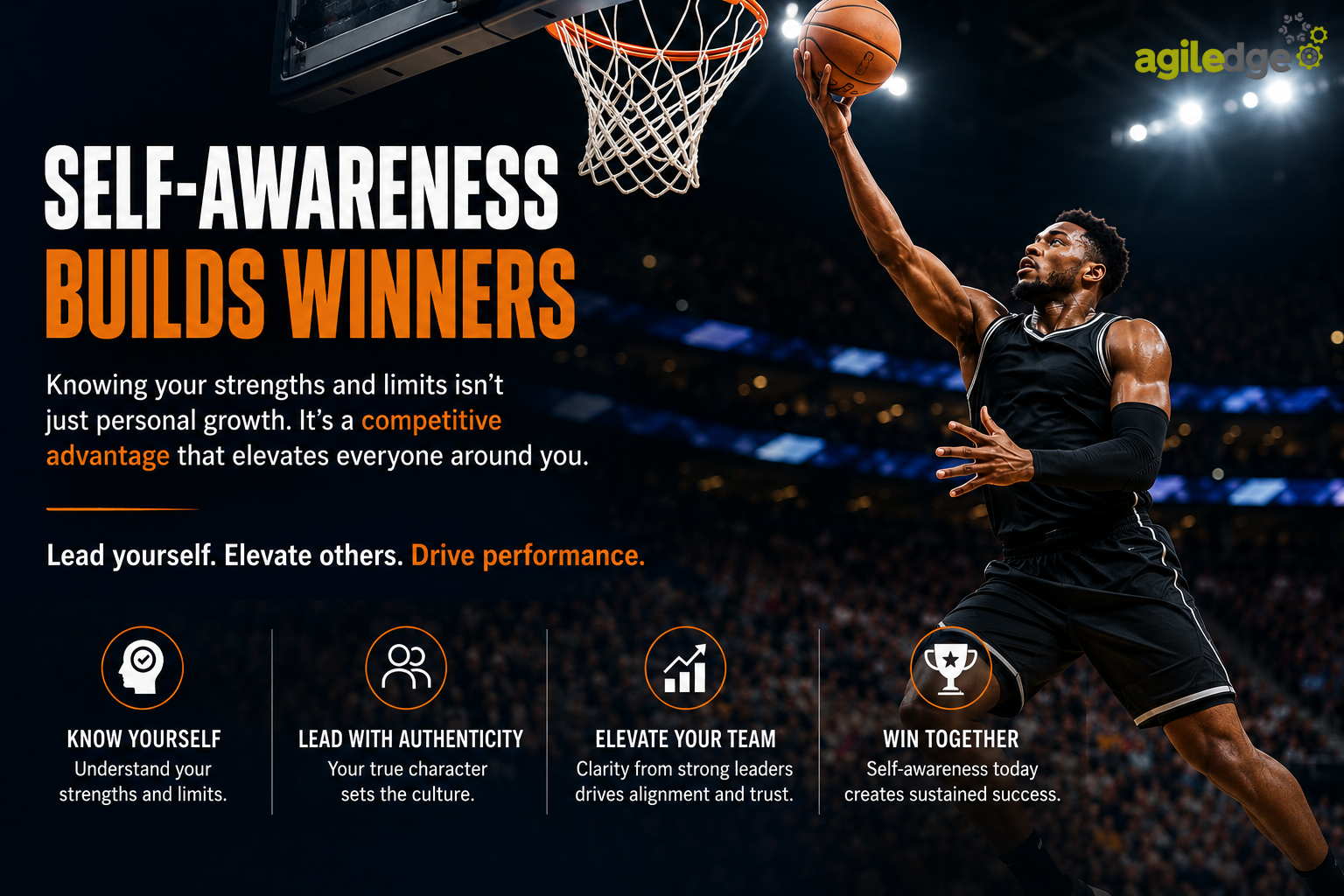
At Agiledge, our collective experience over the last two decades, working with organizations, assessing managers and key contributors and assisting in developing individual and team effectiveness, has led us to believe accurate self-awareness and the ability to apply it consistently is the key to effective managers and key contributors. Knowing your strengths and weaknesses so that you can feature the strengths and lessen dependencies on weak areas is key to high performance.
Self-awareness is not a soft skill. It is the cognitive infrastructure on which sound judgment, authentic leadership, and sustainable organizational performance are built.
Earlier in the month, the NY Knicks demonstrated the value to both self and team awareness. Jalen Brunson was the 33rd overall pick in the 2018 NBA Draft — a second rounder. Dallas never offered him the extension he deserved. He was benched in his first playoff appearance. He was repeatedly underestimated by the people in the best position to evaluate him.
None of this phased him. The consistent testimony from teammates, coaches, and opponents is that Brunson has an unusually stable relationship with his own self-concept — what one observer called "psychopathic competitiveness" paired with genuine leadership presence. His coach at Villanova, at the Mavericks, and now Mike Brown at the Knicks have all described the same quality: the ability to hold an accurate internal read of both his strengths and his limits, without defensive distortion in either direction.
"The top guy on the team sets the culture for the team, and then there's a trickle down from there. It's not a coincidence that they, as a team, have the same personality as their best player."
That's not trivial. It points to something that research surfaces repeatedly: the natural tendencies of a leader — not their aspirational self-presentation, but their actual behavioral patterns under pressure — become the operating norm for the teams around them. Brunson's application of accurate self-awareness, stoicism, his forward-lean into difficult moments, his absence of visible panic when the Knicks trailed by 22 points in the fourth quarter of Game 1 against Cleveland — all of that filtered into how the entire roster responded.
This is what makes self-awareness a competitive asset rather than a personal quality. Brunson's accurate read of himself — what he is, what he isn't, what the team needs from him in specific moments — enabled those around him to calibrate their own roles with unusual clarity. There was no ambiguity about who the Knicks were going through at crunch time. That clarity is a gift to everyone downstream.
The translation to business is is direct. Leaders who carry either inflated or deflated self-concepts — who perform either false confidence or false modesty — create misalignment in the people around them. The team can't calibrate to someone who isn't being honest about who they are. Brunson's greatest leadership contribution may be his transparency of self. A lesson of success for all of us.