
Three PICTs That Ran Through the Entire Championship Arc for the New York Knicks
The PICT framework — Persistent Interdependent Contradictory Tensions — offers a sharper lens than the typical triumph narrative. The Knicks' story is full of tensions that didn't resolve, that were navigated rather than solved, and whose navigation produced either progress or stagnation depending on the moment and the decision-maker. Obviously with their success, a lot more progress was charted by masterfully navigating PICTs (See more on PICTS in appendix)

PICT #1: Continuity vs. Change (The Thibodeau Paradox)
Tom Thibodeau built the Knicks into playoff relevance after years of irrelevance. He developed Josh Hart into a near-triple-double contributor. He created the defensive culture that Brunson needed to thrive. And when the Knicks fired him following their first Eastern Conference Finals appearance since 2000, it was the right decision.
Both things are true simultaneously. The same coaching qualities that drove the rebuild — Thibodeau's uncompromising defensive intensity, his preference for veteran reliability over rotation flexibility, his total commitment to the culture he believed in — had become constraints on what the team needed to become next. Continuity had created the conditions for its own limits.
The firing was, as one analyst described it, a dice roll. It was also the pivot that led them to Mike Brown — a more tactically flexible coach who, notably, had been fired four times in his career and brought exactly that scar tissue of hard learning to the role.
This is the continuity-change PICT in its organizational form. The systems, people, and practices that drive performance systematically accumulate the liabilities that constrain later phases. The tension is never resolved — it recurs at every transition point in an organization's life.
PICT #2: Individual Redemption vs. Team Subordination
Karl-Anthony Towns entered this season carrying the label that had followed him since his time in Minnesota: too soft. Talented, but not built for the physical, grinding moments that define playoff basketball. The Knicks traded for him anyway. And for stretches of this season — including a Christmas Day game where Brown benched him for the crucial fourth-quarter stretch to bring in Mitchell Robinson's defensive energy and offensive rebounding — that reputation had real texture.
What happened next is instructive. Towns didn't sulk. He reportedly accepted the decision, studied what the team needed when he wasn't in, and came back as a more complete player. By the time the Finals arrived, Towns was the secondary offensive weapon the Knicks needed — giving Brunson the space to operate and providing the interior presence that forced the Spurs to adjust their defensive scheme. "Plenty of people wanted the plug pulled on Towns or Bridges at the trade deadline. Instead, the Knicks are being rewarded for a blend of calculated risk-taking, patience and continuity."
The PICT here is between individual validation and team subordination. Towns needed to be effective to justify his trade cost and silence his critics. The team needed him to accept a defined role that might not always showcase his full talent. These are genuinely competing imperatives, and there is no configuration where both are fully satisfied.
What the Knicks managed — through Brown's flexibility and Towns' willingness to be coached — was a dynamic navigation of that tension rather than a resolution of it. Some nights Towns carried the offense. Some nights Robinson played his fourth-quarter minutes. The system was responsive enough to be different things at different times, and neither Towns' ego nor Brown's authority required a permanent settlement of the question.
In organizational settings, this is the high-performer-in-a-defined-role tension. The most talented individuals often need the most flexible management — not because they're difficult, but because their full capability exceeds any single role definition. The organizations that figure out how to keep those individuals engaged and appropriately deployed without creating resentment among teammates are navigating this PICT successfully. It requires ongoing calibration, not a policy.
PICT #3: Patience vs. Urgency (The Draft Pick Question)
The Knicks traded four unprotected first-round picks for Mikal Bridges. They entered this season with the 50th pick in the next draft as their only selection. That bet could have been catastrophic. It will still generate risks in the years ahead. But it also reflects a coherent organizational thesis: that Brunson's prime years coincide with a specific competitive window, and that failing to maximize that window in the name of draft asset preservation would be a different kind of organizational failure.
The patience-urgency PICT runs through every growth organization. Invest now and risk the future. Preserve optionality and underperform the present. Neither choice is wrong in the abstract — both are wrong in the wrong context. The Knicks read their context accurately: Brunson was 28, the roster was close, and the window was open. They acted with urgency. As Josh Hart said with the trophy in his hands: forget those picks.
The more sophisticated version of this lesson isn't about draft picks. It's about effectively managing organizational tensions vs trying to fix a problem that is not fixable in that way. The same tension appears in decisions about when to expand a service line, when to hire ahead of demand, when to invest in capability development versus near-term execution. The organizations that navigate it well have a genuine point of view about their own window — where they are in the cycle, what the opportunity cost of each approach actually is — rather than defaulting to either chronic urgency or chronic caution.
We help organizations navigate these tensions by first understanding their own natural tendencies and then looking more broadly at how organizational decisions are made using a process-oriented approach to impact habits, behaviors and mindsets while promoting resilience, accountability and disciplined intent.
APPENDIX
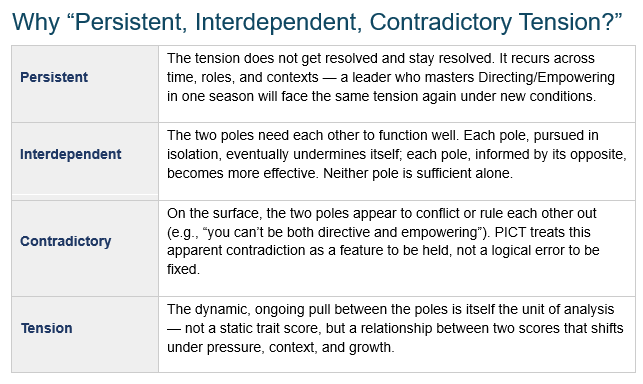
Structural Attributes of a PICT
Beyond the defining acronym, every well-formed PICT shares a common structure:
1. Two Named Poles on a Single Dimension
A true PICT pairs opposites that sit on the same underlying dimension — not two unrelated traits. Short-term ↔ Long-term (time orientation) is a PICT; “Outgoing” paired with “Tolerance of Evasiveness” is not, because they describe different dimensions rather than two ends of one continuum.
2. A Supportive Axis and an Action-Oriented Axis
Across the PICT library, one pole in each pair tends to orient toward supportive qualities (relational, reflective, stabilizing, people-focused) while the other orients toward action-oriented qualities (assertive, executing, changing, task-focused). This second axis is what allows individual PICTs to be plotted against each other and compared structurally — not just read one at a time.
3. A Four-Quadrant Scoring Logic
Because each pole can independently run high or low, every PICT generates four possible profiles, not two:
• High / High — a true strength. Both poles are well developed and mutually reinforcing (e.g., high Directing AND high Empowering: a leader who sets clear expectations and delegates real ownership).
• Low / Low — an overall weakness. Neither pole is available; the person or system has no real position to work from (e.g., neither directive nor empowering — absent, disengaged leadership).
• High / Low (either direction) — an imbalanced perspective. One pole is overdeveloped and running unchecked by its counterpart, producing the recognizable dysfunctions of pure extremes (e.g., high Directing / low Empowering looks like micromanagement; high Empowering / low Directing looks like absent leadership).
This is the critical move PICT makes that a single trait score cannot: it shows that dysfunction is rarely about a trait being “too high” in isolation — it is about that trait running disconnected from its interdependent counterpart.
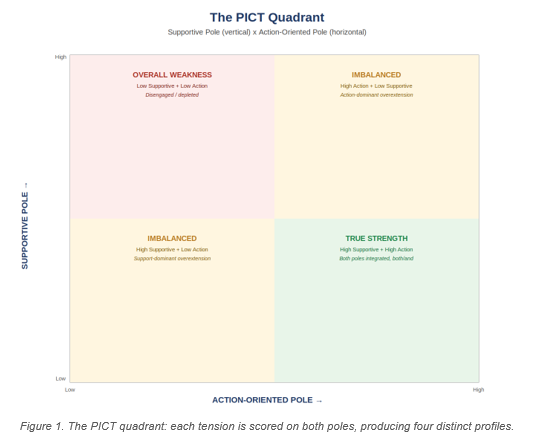
Figure 1. The PICT quadrant: each tension is scored on both poles, producing four distinct profiles.
4. A Both/And Resolution, Not an Either/Or Trade-off
The goal of working with a PICT is never to push a person or organization toward the “right” pole. It is to raise both poles simultaneously — toward the High/High quadrant — and to recognize that the specific blend of “enough of each” shifts by context, role, and moment. This both/and orientation is what separates PICT from conventional strengths/weaknesses or competency-gap models, which implicitly treat each trait as something to simply maximize.
5. Diagnostic, Not Just Descriptive
A PICT is built to be actionable in a debrief or coaching conversation. Each pole carries assessment indicators (observable behaviors that signal where someone sits on that pole), and each quadrant carries a recognizable real-world pattern — so a PICT map functions as a diagnostic tool, not merely a descriptive label.
Worked Example: Directing ↔ Empowering
A leadership PICT drawn directly from Harrison Assessment data and used regularly in AgilEdge debriefs.
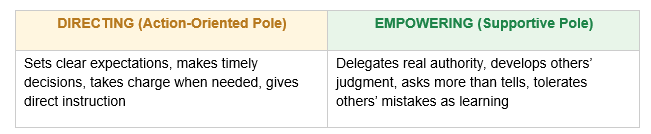
Quadrant interpretation:
• High Directing / High Empowering (True Strength): Clarity-Giving Delegator — sets the destination and the guardrails, then genuinely lets go of the how.
• High Directing / Low Empowering (Imbalanced): Micromanager — control without trust; people execute but don’t grow.
• Low Directing / High Empowering (Imbalanced): Absent Leader — autonomy without context; people are “empowered” to flounder.
• Low Directing / Low Empowering (Overall Weakness): Disengaged — no clarity, no ownership transferred; default drift.
Worked Example: Privacy/Confidentiality ↔ Accountability/Transparency
An organizational-level PICT illustrating that the same structure applies above the individual level.
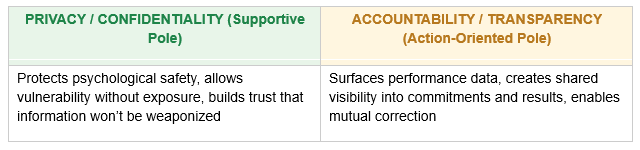
Quadrant interpretation:
• High / High (True Strength): teams that share performance data candidly because psychological safety was established first — transparency is cultivated, not mandated.
• Low Privacy / High Accountability (Imbalanced): weaponized transparency — visibility without safety produces political performance, not honesty.
• High Privacy / Low Accountability (Imbalanced): concealment masquerading as discretion — information is hoarded for self-protection, not genuine confidentiality.
• Low / Low (Overall Weakness): neither safety nor visibility — information is simply absent from the system.
How AgilEdge Uses PICT
• Individual debriefs: reframing a Harrison Assessment paradox score (e.g., Self-Acceptance/Self-Improvement) as a quadrant position rather than a deficiency.
• Team and leadership analysis: identifying where a leadership group is collectively imbalanced on a given PICT, and what organizational risk that imbalance creates.
• Organizational diagnosis: applying PICT logic above the individual level (e.g., Privacy ↔ Accountability, Persistent ↔ Experimenting) to surface systemic, not just personal, tensions.
• Content and thought leadership: using recognizable real-world narratives (sports, current events) as accessible entry points into a PICT’s structure for non-technical audiences.
AgilEdge currently maintains a library of more than 100 PICTs, organized across four domains — Identity, Process, Purpose, and Time — with parent-child relationships among related tensions and a consistent four-quadrant assessment protocol applied throughout.