
Stress Management as System Design, Not Personal Virtue
I was in New York City last week and got to experience the city during 3 of the final games. I grew up in Columbus, Ohio, a sports town, when I was growing up, focused on one team, the Buckeyes and football. So much of what I saw around Manhattan reminded me of that and not what I would have expected a city full of, well, everything. This was interesting, but much more interesting and valuable are the lessons learned from how they got there. How did they achieve the ability to win consistently at that level in a relatively short period of time. When you look at the specifics, I think you’ll agree, It had to do with both how they chose and managed their talent. We see many parallels to what we work with organizations to achieve.
The Knicks trailed by 22 points in the fourth quarter of Game 1 of the Eastern Conference Finals against Cleveland. According to ESPN Analytics, Cleveland had a 99.9% probability of winning with 7:49 remaining. The Knicks won the game 115-104 in overtime. They trailed by 20+ in Game 4 of the Finals, completing the first 20+ point fourth-quarter comeback in recent Finals history. They trailed for much of Game 5 before Brunson's 29 second-half points — 45 for the game — sealed the championship.
Three of their five most critical wins this postseason required the team to perform well while losing. It was not luck. It was a system they consciously developed.
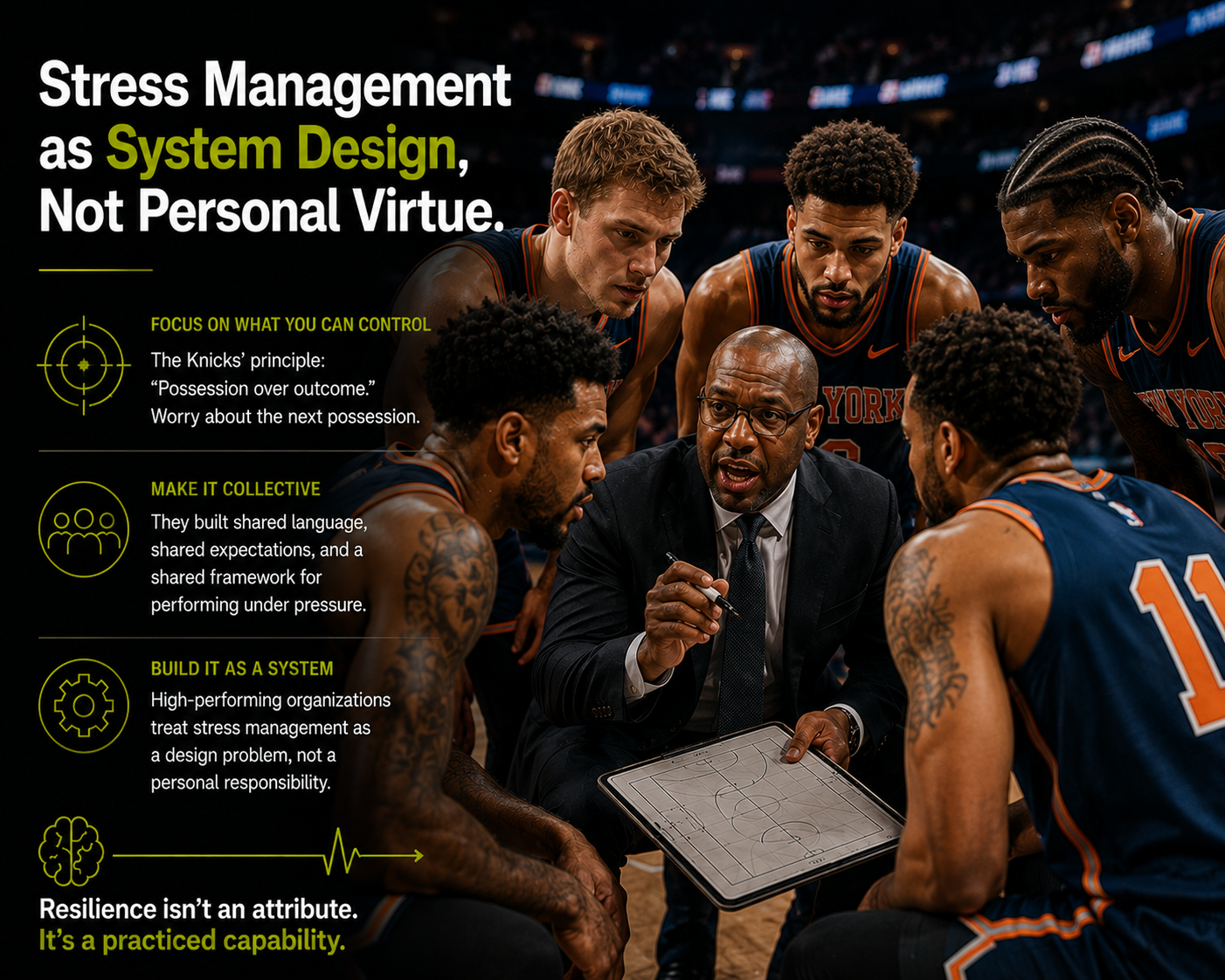
Their coach, Mike Brown has a phrase for it. He repeated it so often this season that it became a kind of organizational doctrine: "Possession over outcome. Just worry about the next possession. Lock into the details, play as hard as you can, give everything you can until that next possession. Don't worry about the outcome of the game or the series."
This is not a motivational slogan. It's a stress management architecture. By deliberately narrowing the cognitive scope of each player from "we're down 22 points in the fourth quarter of a critical playoff game" to "what does the next possession require," Brown eliminated the most common sources of performance breakdown under pressure: future-orientation, catastrophic framing, and fixating on the outcome.
The psychological research on this is very clear. Performance anxiety is largely a product of attentional misallocation (Eysenck et al., 2007). The brain spending cognitive resources on non-actionable future states rather than actionable present-moment demands. Top performers in sports and in business, under pressure don't feel less stress than average performers. They have better mechanisms for directing attention away from the stress signal and toward the task.
What made the Knicks' model interesting is that it was collective, not individual. Brown didn't ask each player to manage their own anxiety privately. In organizations, we often see it addressed in this matter or unfortunately not addressed at all. He gave the entire team a shared framework — a phrase that became a coordination mechanism. When OG Anunoby told his teammates at halftime of the Finals "We've come back plenty of times when we're behind" and "We're fine. Stay with it, we're fine," he was activating the same cognitive reframe Brown had installed as an operating norm all season.
The organizational parallel is direct. Most organizations treat stress management as a personal responsibility — something individual employees either have the capacity for or don't. High-performing organizations treat it as a design problem. They create shared language, shared protocols, and shared behavioral norms (based on highly accurate self and team awareness) that function as stress management infrastructure for the group. They build the comeback muscle in practice, not just in crisis.
The Knicks had rehearsed this. They had come back from 18 points against Houston in February, 17 points at Christmas against Cleveland, 20+ points in back-to-back games against Boston the prior season. Their resilience wasn't an attribute. It was a practiced skill and a collective expectation. It was system, cognitively activated by a slogan, but developed, not just by practice, by building effective relationships and team awareness. The foundation though was strong relationships and a deep understood each other’s natural tendencies (behaviors) and roles. More specifics on this to follow.
Source:
Eysenck, M. W., Derakshan, N., Santos, R., & Calvo, M. G. (2007). Anxiety and cognitive performance: Attentional control theory. Emotion, 7(2), 336–353.