
Clarity First. Performance Next.
The AgilEdge Manifesto
We focus on one thing
Helping organizations realize the full potential of their people — to get the right people in the right roles doing the right stuff at the right time.
Most leaders agree that is the objective. Far fewer can explain how they do it, or whether they can do it at all. When it comes to people decisions and judgments, many still operate in a self-imposed fog, as if it were 1999.
That fog is no longer necessary. There are highly effective ways to understand suitability for a job, role, task, or project. You can develop a predictive, accurate understanding of an individual’s natural tendencies, motivations, aspirations, competencies, and values. You can distinguish eligibility — skills and credentials — from suitability, the behavioral and interpersonal fit that actually determines whether the work gets done.
We have spent twenty-five years doing exactly that. It works. And after twenty-five years, we have to say plainly what it does not do.
It is not enough
Clarity about people is necessary. It is not sufficient.
We have watched capable, well-selected, self-aware people fail to produce results — not because we misread them, and not because they lacked ability, but because their ability could not be used. The decision was not theirs to make. The signal never reached them. The feedback closed nowhere. The record said one thing and the floor said another.
Capability is not a fund that gets spent. It is a capacity that either gets deployed or sits idle. When it sits idle, the cause is almost never the person.
So we widened the question.
There are two planes, and two kinds of fog
Work happens on two planes at once.
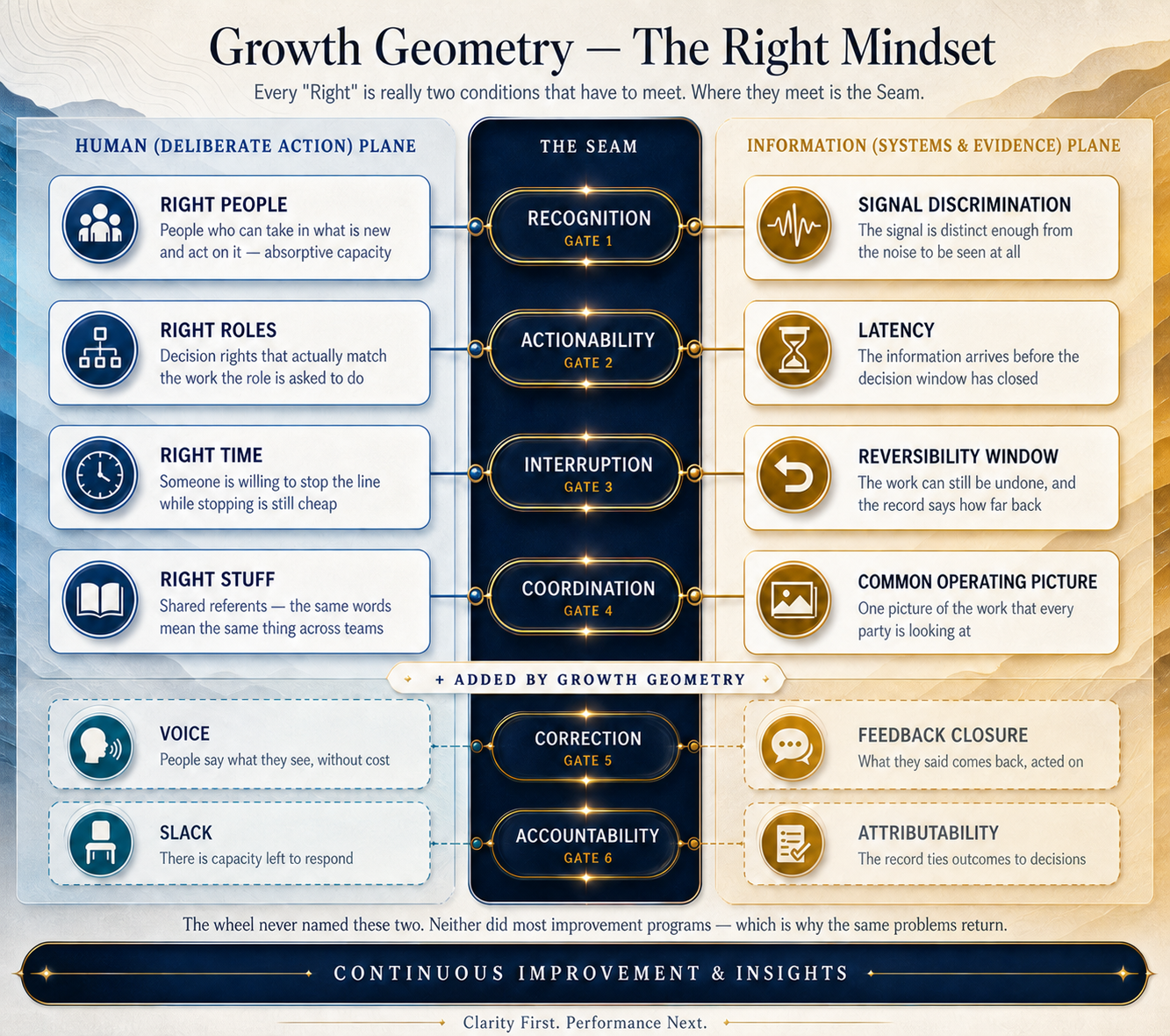
The human plane is deliberate action — the cognitive, physical, and social acts where a person could have done otherwise. Judgment, decision, coordination, voice, restraint. This is the plane we have always worked in, and it is where the fog we named first — the people stuff — sits.
The information plane is signal, representation, and record — what the organization can detect, represent, retain, and act on. It has its own three-story fog, identical in shape: what the record actually holds, what the dashboard is assumed to say, what the evidence could and should tell you. Call it the signal stuff.
Between them runs, what we term, the Seam. This is the place where a person meets the evidence and the system and something either happens or does not.
This is the claim that reorganizes everything else we do:
The clarity that matters is not on either plane. It is at the Seam. And a Seam is only as strong as its weaker side.
You can achieve total clarity about your people and total clarity about your data and still be stuck, because the two never couple. That failure is invisible to any method that examines one plane at a time — which is nearly all of them, including, we say out loud, our own best instruments. A behavioral assessment is structurally silent about whether decision rights exist, whether feedback closes, whether the intervention window is still open. Silent. Not weak — silent.
Anyone selling you people clarity alone is selling you half a Seam.
Gates and levers
Some conditions govern the level of what an organization can achieve. Others govern the rate at which it improves. Confusing the two is the single most expensive error we encounter.
Gates are threshold conditions. They are necessary, not contributory. A closed gate is not offset by excellence elsewhere — no amount of engagement compensates for the absence of decision rights, and no dashboard compensates for a feedback loop that closes nowhere. Gates explain why improvement fails.
Levers are additive. Sense, seize, transform. They compound, they respond to effort, and they are where growth actually lives.
A process is a repeated path across the Seam. Process work is lever work on that path. It is the improvement.
Growth Geometry reverses the order of the questions. It does not ask what you could add. It asks what is holding the ceiling down. Then it asks the additive questions, in the light of the answer.
We reject scoring models that let a strong score paper over a closed condition. That is not rigor. That is arithmetic laundering of a constraint.
Shape and direction
Two things describe where an organization actually stands.
Shape is its constraint profile — which conditions are open, which are thin, which are closed, and which we simply cannot read yet from the evidence available. Thin matters as much as closed: a condition that is present but underpowered fails quietly, and gets misdiagnosed as a motivation problem.
Direction is its position on the curve — whether the current configuration is still climbing, flattening, or approaching the point where it stops holding altogether.
Shape without direction tells you where you are stuck today. Direction without shape tells you the weather but not the vessel. You need both, read together, inward and outward — because the constraint is as often at the boundary with customers, patients, regulators, and markets as it is inside the building.
Why the gates stay closed: PICT
Most closed conditions are not oversights. They are the residue of a tension somebody had to resolve and resolved badly.
PICTs — Persistent Interdependent Contradictory Tensions — are the tensions that never go away because both sides are legitimate. Standardization and adaptation. Autonomy and alignment. Speed and deliberation. Variation and commitment. They cannot be solved. They can only be navigated, continuously, and the navigation itself changes as conditions change.
Binary thinking treats a PICT as a problem with an answer. It picks a pole, over-rotates, and closes a gate on the other side — usually while congratulating itself on decisiveness. That is how a company ends up with excellent standard work and no capacity to sense that the standard has stopped fitting. It is how doing conventional efficiency well eventually gets a firm bypassed, no matter how efficient it becomes.
PICT is the interpretive layer beneath the constraint reading — the discipline that explains why a specific condition is closed and what it would cost to open it, including what you would be giving up. Two organizations can have identical constraint shapes for opposite reasons and need opposite interventions. PICT is how we tell them apart.
Both/and is not a temperament. It is a method, and it is repeatable.
What we will not do
A manifesto should say what it refuses.
We will not issue a single composite score (although we do have an assessment that provides a probability - not a composite). A number that averages a closed condition against a strong one destroys the only information worth having.
We will not promise a percentage before we have a baseline. No thirty-percent reduction in anything, quoted from someone else’s study, in someone else’s industry.
We will not lead with our framework. We lead with your problem. The methodology belongs in the appendix, where it can be examined rather than admired.
We will not claim a gap exists because we could not find evidence of one. Absence from public view is not absence.
We will not tell you that you lack a capability you already have. More often, our work is to connect capabilities you have already paid for and that are not reaching each other.
We will not pretend an instrument measures what it does not. Where our tools are silent, we say so, and we go find something that is not.
What clarity buys you
Choosing high performers, and knowing why.
Selecting for suitability, not only eligibility.
Teams with higher trust, adaptability, and consistency — and results that are consistent and adaptive.
People who understand their own roles, strengths, and motivations, and can therefore be developed rather than sorted.
Leaders who can recognize a PICT before it becomes a closed gate.
Visibility into how the work actually moves — through the informal network of connectors, brokers, gatekeepers, and hidden value creators, where reporting lines are a minor detail and the real roles are usually misunderstood or ignored.
The location of the one condition holding the ceiling down, and an honest account of what opening it would cost.
Management decisions that move from “I think” to “I know.”
Our commitment
At AgilEdge, our purpose and commitment is to use the optimal tools, processes, and plans to achieve the clarity needed to make more effective people, process, and technology decisions for every organization we serve.
We do not believe people clarity is the whole answer. We believe it is one plane of a two-plane problem, and that the work worth doing is at the Seam.
Clarity First. Performance Next.

Many leaders in organizations will agree that this is a key objective and many of these same leaders have trouble explaining how they do it or even can do it. When it comes to people decisions and judgments, many operate needlessly in a self-imposed fog as if it's still 1999. There are highly effective ways for understanding job (role, task, project) suitability. You can develop a predictive and accurate understanding of each individual's natural tendencies, motivations, aspirations, competencies and values. But it's only part of the opportunity, as with this understanding, you can accomplish three powerful outcomes:
Leveraging new-found clarity by turning B performers to A and moving on without the C's.
Impacting mindsets to improve clarity in making strategic and daily leadership decisions especially regarding the many PICTs (Persistent Interdependent Contradictory Tensions) faced daily
Providing the clarity (understanding) to achieve a dynamic state where employees feel empowered, purposeful, fulfilled and free to challenge the status quo.
But it's not enough to assure success- there's another often missed opportunity to prove the clarity necessary to make better people and organizational decisions. There are good reasons why organizations are organized at least somewhat hierarchically. Reporting gets done through these hierarchies and matrices, however the work gets done through informal networks where your title is a minor issue but where the roles (Connector, gatekeeper, liaison, representative, knowledge broker, energizer-influencer, De-energizer, hidden value creator, bottleneck, isolate, peripheral specialist…) dictate both quality and quantity of your work. The problem and the opportunity is that more often than not, these roles are not only misunderstood, but often ignored. It's 2026 and you now can solve this problem cost effectively with the powerful data to bring clarity to your decisions and actions.
At Agiledge, our purpose and commitment is to use the optimal tools, processes and plans to achieve the clarity needed to make more effective, people, process and technology decisions for each organization we serve.
Clarity First, Performance Next…
With the clarity, you can …
Choose high performers and understand why leading to…
Providing the best path for people to achieve their potential through self-awareness and focused development.
Build more effective high performing teams operating with higher trust, adaptability and performance consistency.
Be prepared for what comes at you with an understanding of bench strength and a meaningful.
Improve execution with people who understand their roles, strengths, and motivation leading to…
Achieve results that are consistent and adaptive.
Select people not only for eligibility (skills/credentials) but also for suitability (behavioral fit, interpersonal competencies).
Adopt more effective mindsets by understanding how to navigate PICTS and the influence of their own natural tendencies.
Maintain processes that channel both technical ability and relational effectiveness.
Achieve People Clarity which enables Process Clarity meaning: Processes only stick when people see themselves in them and bring them to life with ownership, judgment, and energy.
Identify Hidden Influencers: Reveal "informal leaders" who colleagues turn to for advice, regardless of their official job title.
Predict Flight Risks: Detect isolation or a sudden drop in connectivity, which often precedes an employee’s resignation.
Identify High-Potential (HiPo) Candidates: Spot individuals who act as "bridges" across departments, a key trait of future leaders.
Optimize Mentorship: Match mentors and mentees based on actual expertise-sharing patterns rather than just seniority or guesswork.
Reduce Turnover Contagion: Identify key nodes in the network whose departure might trigger a "ripple effect" of other resignations.
Break Down Silos: Pinpoint exactly where departments are failing to communicate and create targeted interventions to link them.
Reduce Collaborative Overload: Identify "bottleneck" individuals who are overwhelmed by requests, helping to redistribute their workload.
Identify Single Points of Failure: Find "knowledge hoarders" or individuals who are the only link between two critical groups.
Streamline Decision-Making: Uncover where informal "gatekeepers" are slowing down processes or adding unnecessary layers of approval.
Optimize Meeting Culture: Use interaction data to reduce redundant meetings and identify which sessions are actually driving value.
Quantify "Invisible Work": Give credit to people who spend significant time helping others
Boost Cross-Functional Innovation: Identify "brokers" who sit between diverse groups and are most likely to spark "aha!" moments.
Shorten R&D Cycles: Map the flow of technical information to ensure that ideas move quickly from creators to executors.
Customer Success Integration: Map how well sales, support, and product teams are communicating to solve client issues.
Identify "Idea Graveyards": Locate parts of the network where information flows in but rarely Audit Cultural Health: Identify "pockets of toxicity" or isolated sub-cultures that may be diverging from company values.
Improve Workplace Belonging: Identify "peripheral" employees who are at risk of disengagement due to a lack of social ties.
Facilitate Change Management: Identify the best "Change Agents" to champion new initiatives based on their reach and trust within the network.
Map Expertise: Create a dynamic "Internal Yellow Pages" based on who people actually go to for specific technical questions.
Resource Allocation: Reallocate budget or headcount to "hidden" hubs of activity that are currently under-resourced.
Clarify Informal Roles: Distinguish between "Central Connectors" (high volume), "Brokers" (high reach), and "Peripheral Players" (niche experts).
Move management decisions from "I think" to "I know." Transform the subjective feeling of organizational culture into objective, actionable data.