
Tipping Points and the Next S-Curve: What Brazil, Norway, and England Just Taught Us
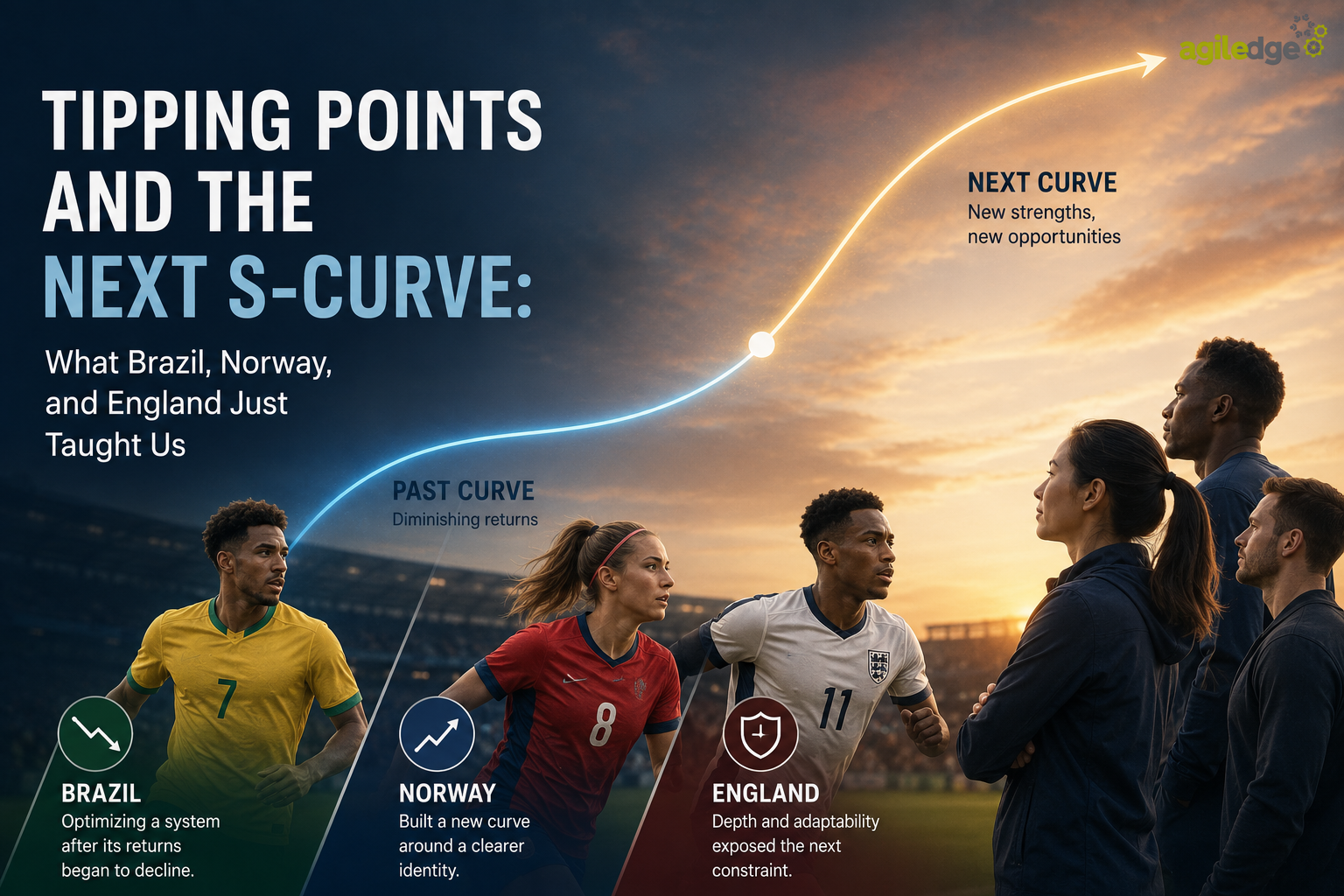
Six days ago, Norway beat Brazil 2–1 and reached its first World Cup quarterfinal. Six days later, England ended Norway’s historic run with a 2–1 extra-time victory.
At first, this looks like a familiar sporting cycle: one surprise team defeats a traditional power, then loses to another. But it offers a more useful lesson for leaders: moving onto a new S-curve can create a breakthrough without creating permanent advantage.
Brazil: optimizing a system after its returns had begun to decline
Brazil did not lose because it lacked talent. It lost while being unusually unable to control the match. Norway held 60% of FIFA’s measured possession and attempted 683 passes to Brazil’s 347.
The result continued a deeper pattern. Every Brazilian World Cup elimination since its 2002 championship has come against European opposition. Six consecutive exits suggest more than bad luck. They point to a system repeatedly trying to solve a changed competitive problem with capabilities that once defined its superiority.
This is a common organizational failure: treating a structural shift as another familiar tension to manage, then applying more effort to a system whose returns have already begun to invert.
Norway: building a new curve around a clearer identity
Norway did not defeat Brazil by imitating Brazil. It built a system around its own strengths: physical power, midfield control, direct progression, aerial threat, and Erling Haaland’s extraordinary finishing.
Norway entered the tournament after winning all eight qualifying matches and then advanced further than at any previous World Cup. That was not simply incremental improvement. It reflected a reorganized identity—a new S-curve created while many competitors were still optimizing older ones.
England: one successful curve-jump is not the end
England’s victory does not invalidate Norway’s transformation. It reveals its next constraint.
England ended Haaland’s run of scoring in 14 consecutive competitive internationals and survived after Norway took an early lead. Jude Bellingham scored twice, including the extra-time winner.
The match was close and hardly proved that England had solved every problem. But England possessed one advantage associated with a more mature system: a multi-generational core, greater squad depth, and several ways to remain dangerous when the opponent’s defining weapon was contained.
Norway had created a powerful identity. England exposed the next question: could that identity produce enough depth and adaptability when Haaland was neutralized?
The leadership lesson
Leaders must hold two truths simultaneously.
Recognizing a tipping point and acting on it is rare. Most organizations continue optimizing the old curve, interpreting declining returns ….
But successfully moving onto a new curve does not end the discipline that produced the breakthrough. It moves the organization into a more demanding competitive environment, where the next constraint may already be emerging.
That is the real lesson from Brazil, Norway, and England:
A new S-curve buys a new period of growth—not permanent altitude.
Growth leaders do not reinvent once and coast. They build the continuing capacity to recognize when today’s successful model is becoming tomorrow’s constraint.