
Talent and Leadership Practices that are Producing Results at the World Cup
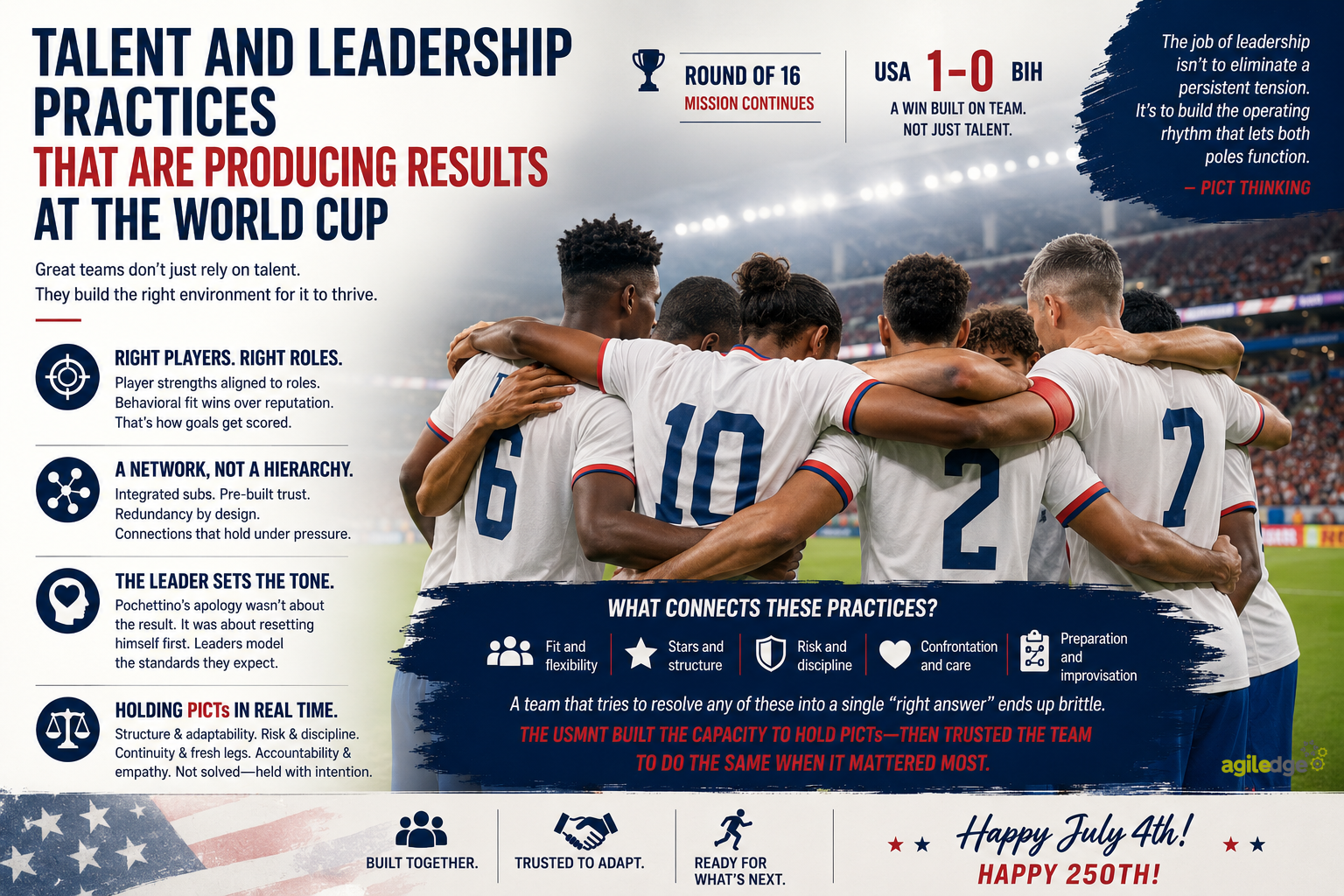
We’re going to switch our focus from the Knicks and Basketball to the World Cup and the US Teams’ relative success so far. We’ll try to draw some parallels to the mindsets and practices we promote in our work. The U.S. Men's National Team's win over Bosnia-Herzegovina was its first World Cup knockout victory since 2002. It was achieved while playing more than half a match down a man. There is a simple lesson here. If you assemble a talented team and ensure they coalesce. You will benefit. The more useful story, and the one with something to teach any leadership team, is what Mauricio Pochettino's staff did before kickoff to make this resilience possible.
Balogun's early goal and Tillman's late free kick both came from players deployed into roles that matched their natural tendencies (trait profiles). Decisiveness in the box for one, composure under a dead ball for the other. Building a roster on behavioral suitability person-role fit, not just star power, is the same discipline followed by those who use effective behavioral assessments to assist tin building effective management teams. You can build an effective team deliberately and not by reputation alone. In business, this is often not done well.
When your leading scorer is sent off in the 64th minute and you have to play down not just a man, but potentially your best. When this happens, you find out fast whether your team is a network or a hierarchy with one very important box at the top. The substitutes who came on (Reyna, Pepi, Berhalter ) weren't emergency fixes; they were already woven into the passing and trust network through repetition. That's an Organizational Network Analysis principle in practice: map your connectors and your redundancy gaps before a crisis forces you to discover them live.
If you assess how they got to where they are and how they prevailed, you will see the conscious navigation of persistent, yet contradictory tensions (PICT) including but not limited to the following: 1. Structure and adaptability. 2. Individual risk and collective discipline. 3. Continuity and fresh legs. 4. Holding accountable and showing empathy. None of these were "solved" over the course of the tournament — they were held, in real time, match to match. That's PICT thinking in its most practical form: the job of leadership isn't to eliminate a persistent tension, it's to build the operating rhythm that lets both poles function without one collapsing the other.
Mauricio Pochettino’s apology after the U.S. loss to Türkiye was a small moment with a large leadership lesson. The result itself did not change the team’s standing. The U.S. had already won the group. But Pochettino recognized that his postgame tone had created its own issue. Before asking his players to reset emotionally for the knockout round, he reset himself. That matters in business, too. Leaders often want accountability, composure, and emotional discipline from their teams. But those norms rarely take hold when the leader is not willing to model them first.
Notice what connects these practices: none of them is a single lever. Fit and flexibility. Stars and structure. Risk and discipline. Confrontation and care. Preparation and improvisation. A team that tries to resolve any of these into a single "right answer" ends up brittle. The USMNT's run so far looks less like a story about individual brilliance and more like a story about a coaching staff that built the capacity to deal with PICTs. Then, with this capability, they could trust the team to do the same under real pressure, with a man down, on the road to the Round of 16. Enjoy your July 4th and Happy 250th!