
Your AI Is Fast. Your Organization Isn't.
Your organization just bought an AI tool that makes analysts three times faster. Six months later, the quarterly numbers look the same. Nobody lied about the speed. The speed was real. It just never reached the customer.
This is the most expensive misunderstanding in management right now, and Peter Drucker named it decades ago. Efficiency is doing things right; effectiveness is doing the right things (Drucker, 2020). AI is an extraordinary efficiency engine. Whether it makes an organization more effective depends on something the tool cannot see: the rest of the system it was dropped into.
The gain has to travel
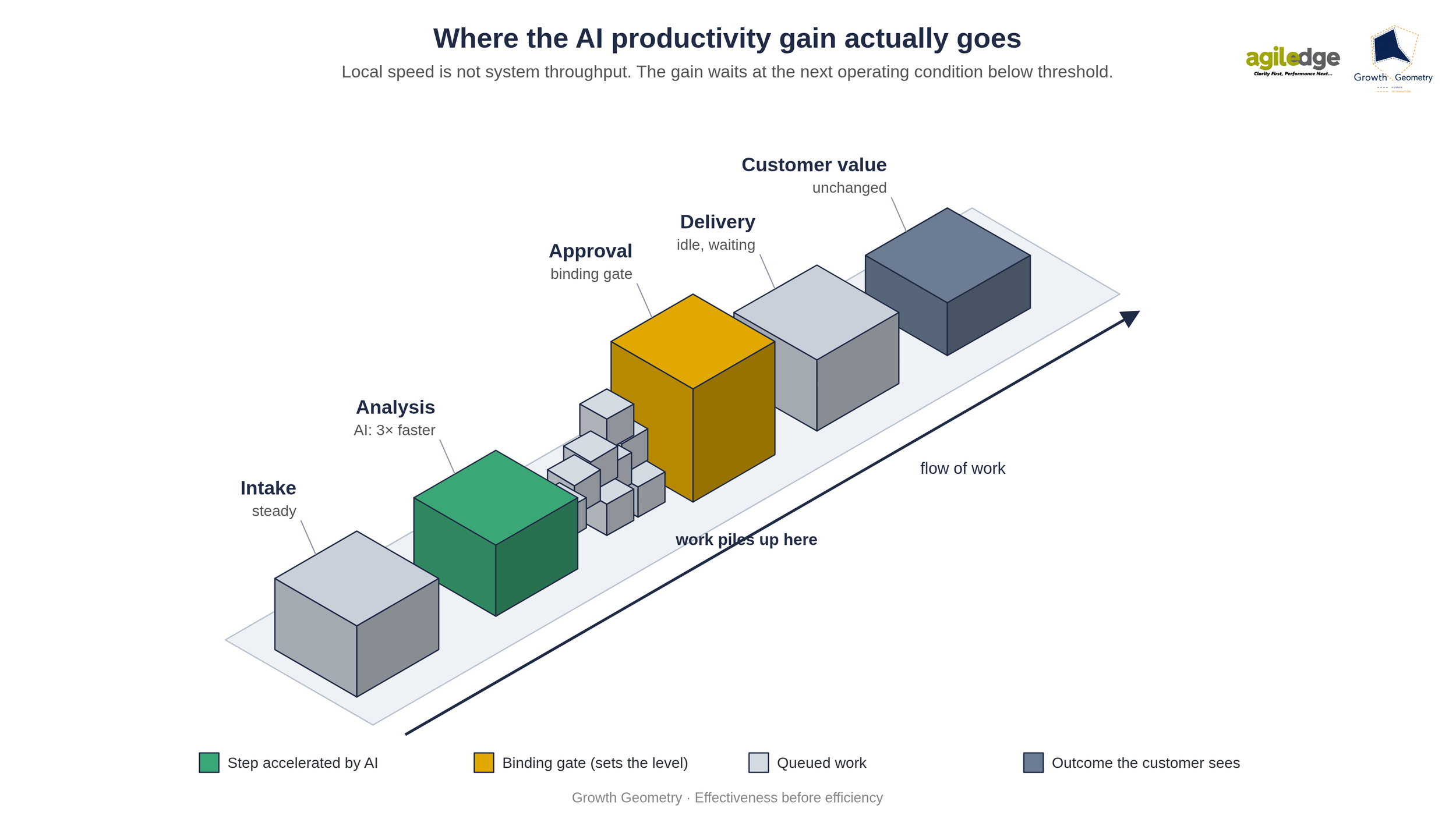
Picture a factory that triples the speed of one production step while the next station remains unchanged. More work reaches that station, but it cannot process the additional volume. A queue grows, while the number of finished products reaching customers stays the same. The local improvement is real, but the organization gains nothing until it addresses the downstream constraint.
Most AI deployments work the same way. Faster analysis produces more recommendations for an approval committee that still meets every other Thursday. Faster coding fills the testing queue. Faster content creation doubles the review load on the two people allowed to sign off. The local step improves; the flow of value does not. PwC's 2026 Global CEO Survey, cited in our white paper, found that a large share of CEOs reported no significant financial benefit from AI despite rapid adoption. That is not a technology failure. It is a geometry problem.
What Growth Geometry adds to Drucker
Drucker advises us on the first question: is this activity worth doing at all? Growth Geometry adds the second one: when this activity gets faster, where does the gain go?
In Growth Geometry, a gate is an operating or flow condition, the circumstance required for work to move from one part of the system to the next. Gates are threshold conditions. Below threshold, no amount of effort elsewhere compensates. In the example above, the binding gate is not analytical speed. It is decision rights and decision latency: who is allowed to act on the analysis, and how long the analysis waits before someone does. Accelerating the step in front of that gate does not raise the level of the system. It just moves the pile of waiting work to a new address.
And there is rarely only one pile. The honest diagnostic output is the full set of conditions currently below threshold, not a single villain to fix and forget. An organization might have a thin approval gate, a thin feedback loop from customers, and a data handoff that nobody owns, all at once. The AI tool will expose every one of them.
Three questions before your next AI rollout
Before approving the next productivity tool, leaders can ask three questions that Drucker would recognize and that Growth Geometry makes concrete.
What outcome is this supposed to change? Not "hours saved," but a customer result, a decision made sooner, a margin protected. If the answer is only speed, the investment is efficiency without a destination.
What sits immediately downstream? Map the next two handoffs. If the step after the accelerated one is capacity-constrained, slow to decide, or dependent on a scarce approver, the gain will stall there.
Who can act on the faster output, and are they allowed to? Many AI gains die in the gap between having an answer and having the authority to use it. That gap is a decision-rights problem, and no model upgrade will close it.
Both/and, not either/or
None of this argues against efficiency. The tension between speed and effectiveness is persistent and interdependent: an organization that ignores efficiency becomes uncompetitive, and one that pursues it without direction becomes very fast at the wrong things. The goal is to hold both. Use AI to make work faster, and use the geometry of the system to make sure faster work actually arrives somewhere that matters.
Drucker's principle holds. What has changed is the size of the gap between activity and value, because the tools that widen activity have never been more powerful. Or, as we put it in Growth Geometry: One thing is stopping you. Everything else you fixed is waiting on it.
Read the full white paper: Is Peter Drucker Still Relevant? Reframing Management Through Growth Geometry → [CLICK HERE], which examines effectiveness, knowledge work, planned abandonment and decentralization through the Growth Geometry lens.