
We focus on ONE thing, helping organizations realize the full potential of their people to enable
Getting the Right People in the Right Roles Doing the Right Stuff at the Right Time
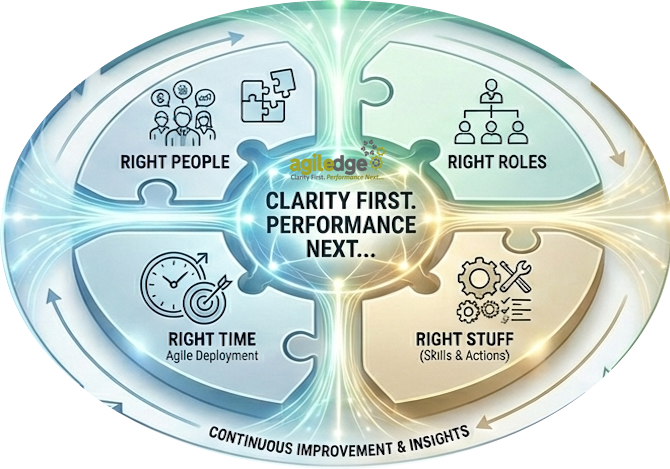

Many leaders in organizations will agree that this is a key objective and many of these same leaders have trouble explaining how they do it or even can do it. When it comes to people decisions and judgments, many operate needlessly in a self-imposed fog as if it's still 1999. There are highly effective ways for understanding job (role, task, project) suitability. You can develop a predictive and accurate understanding of each individual's natural tendencies, motivations, aspirations, competencies and values. But it's only part of the opportunity, as with this understanding, you can accomplish three powerful outcomes:
Leveraging new-found clarity by turning B performers to A and moving on without the C's.
Impacting mindsets to improve clarity in making strategic and daily leadership decisions especially regarding the many PICTs (Persistent Interdependent Contradictory Tensions) faced daily
Providing the clarity (understanding) to achieve a dynamic state where employees feel empowered, purposeful, fulfilled and free to challenge the status quo.
But it's not enough to assure success- there's another often missed opportunity to prove the clarity necessary to make better people and organizational decisions. There are good reasons why organizations are organized at least somewhat hierarchically. Reporting gets done through these hierarchies and matrices, however the work gets done through informal networks where your title is a minor issue but where the roles (Connector, gatekeeper, liaison, representative, knowledge broker, energizer-influencer, De-energizer, hidden value creator, bottleneck, isolate, peripheral specialist…) dictate both quality and quantity of your work. The problem and the opportunity is that more often than not, these roles are not only misunderstood, but often ignored. It's 2026 and you now can solve this problem cost effectively with the powerful data to bring clarity to your decisions and actions.
At Agiledge, our purpose and commitment is to use the optimal tools, processes and plans to achieve the clarity needed to make more effective, people, process and technology decisions for each organization we serve.
Clarity First, Performance Next…
With the clarity, you can …
Choose high performers and understand why leading to…
Providing the best path for people to achieve their potential through self-awareness and focused development.
Build more effective high performing teams operating with higher trust, adaptability and performance consistency.
Be prepared for what comes at you with an understanding of bench strength and a meaningful.
Improve execution with people who understand their roles, strengths, and motivation leading to…
Achieve results that are consistent and adaptive.
Select people not only for eligibility (skills/credentials) but also for suitability (behavioral fit, interpersonal competencies).
Adopt more effective mindsets by understanding how to navigate PICTS and the influence of their own natural tendencies.
Maintain processes that channel both technical ability and relational effectiveness.
Achieve People Clarity which enables Process Clarity meaning: Processes only stick when people see themselves in them and bring them to life with ownership, judgment, and energy.
Identify Hidden Influencers: Reveal "informal leaders" who colleagues turn to for advice, regardless of their official job title.
Predict Flight Risks: Detect isolation or a sudden drop in connectivity, which often precedes an employee’s resignation.
Identify High-Potential (HiPo) Candidates: Spot individuals who act as "bridges" across departments, a key trait of future leaders.
Optimize Mentorship: Match mentors and mentees based on actual expertise-sharing patterns rather than just seniority or guesswork.
Reduce Turnover Contagion: Identify key nodes in the network whose departure might trigger a "ripple effect" of other resignations.
Break Down Silos: Pinpoint exactly where departments are failing to communicate and create targeted interventions to link them.
Reduce Collaborative Overload: Identify "bottleneck" individuals who are overwhelmed by requests, helping to redistribute their workload.
Identify Single Points of Failure: Find "knowledge hoarders" or individuals who are the only link between two critical groups.
Streamline Decision-Making: Uncover where informal "gatekeepers" are slowing down processes or adding unnecessary layers of approval.
Optimize Meeting Culture: Use interaction data to reduce redundant meetings and identify which sessions are actually driving value.
Quantify "Invisible Work": Give credit to people who spend significant time helping others
Boost Cross-Functional Innovation: Identify "brokers" who sit between diverse groups and are most likely to spark "aha!" moments.
Shorten R&D Cycles: Map the flow of technical information to ensure that ideas move quickly from creators to executors.
Customer Success Integration: Map how well sales, support, and product teams are communicating to solve client issues.
Identify "Idea Graveyards": Locate parts of the network where information flows in but rarely Audit Cultural Health: Identify "pockets of toxicity" or isolated sub-cultures that may be diverging from company values.
Improve Workplace Belonging: Identify "peripheral" employees who are at risk of disengagement due to a lack of social ties.
Facilitate Change Management: Identify the best "Change Agents" to champion new initiatives based on their reach and trust within the network.
Map Expertise: Create a dynamic "Internal Yellow Pages" based on who people actually go to for specific technical questions.
Resource Allocation: Reallocate budget or headcount to "hidden" hubs of activity that are currently under-resourced.
Clarify Informal Roles: Distinguish between "Central Connectors" (high volume), "Brokers" (high reach), and "Peripheral Players" (niche experts).
Move management decisions from "I think" to "I know." Transform the subjective feeling of organizational culture into objective, actionable data.